Quarterly Business Review Template for Agencies
A quarterly business review template is the agenda and slide structure an agency uses to run a QBR: a relationship health check, the quarter's numbers against target, wins and risks, stakeholder coverage, and next quarter's agreed actions. Most quarterly business review templates online are generic slide galleries built for any industry. This one is built specifically for agencies and professional services firms.
What a quarterly business review template contains
A good QBR follows the same eight-part structure, because the shape of a good QBR doesn't change much between firm types, even when the numbers on the slides do. The deck runs:
- Relationship health snapshot. A one-page RAG view across satisfaction, engagement, relationship depth and growth readiness.
- The quarter in numbers. A scorecard of target versus actual, with a trend column.
- Wins and challenges. What went well, and what needed attention, side by side.
- Stakeholder coverage. Who's engaged, who's gone quiet, and who holds the budget.
- Risks and mitigations. Named risks, likely impact, and what's being done about each one.
- Where this account can grow. Expansion signals and a suggested next step for each.
- Agreed actions. Owners and dates for next quarter, plus space for the client's own priorities.
- Appendix: agency metrics sheet. A one-page reference the account team fills in before the meeting and keeps on file.
How to use the QBR template, step by step
A quarterly business review template is only as good as what goes into it. Here's what each section is actually for, and what a good answer looks like.
Relationship health snapshot
Rate each of the four boxes green, amber or red, and write one line explaining why. Not "amber because things are a bit quiet," but the specific thing that's true: decision-maker hasn't been on a call in six weeks, or client flagged budget pressure twice this quarter. The reason is the useful part. The color is just a flag to the reader that a reason exists.
If you run Kaizan, this slide doesn't need to be rebuilt from memory each quarter. It maps directly onto what we call The Evidence-Based Client Health Standard (the CARE methodology), which scores every account on client satisfaction, engagement activity, relationship strength and expansion readiness continuously from the real conversation history, not a monthly guess.
The quarter in numbers
Pull these the morning of the review, not the week before. A stale number is the fastest way to lose a room that's checking your figures against their own dashboard in real time. Fill in target, actual, and a trend arrow against last quarter, not just this quarter in isolation: a single number with no comparison tells the client nothing about direction.
Wins and challenges
Three wins, three challenges, each with one sentence of detail. The challenges column is the one agencies are tempted to thin out. Don't. A QBR that only ever shows good news reads as curated, and clients notice. Kaizan's own research across more than a million agency client calls found that roughly 69% of accounts that later became genuinely at risk had raised a concern in conversation at least once before anyone treated it as a risk on paper, and about 38% raised the same concern more than once. The accounts that stayed are usually the ones where that kind of signal made it onto a slide instead of staying in a transcript nobody reread.
Stakeholder coverage
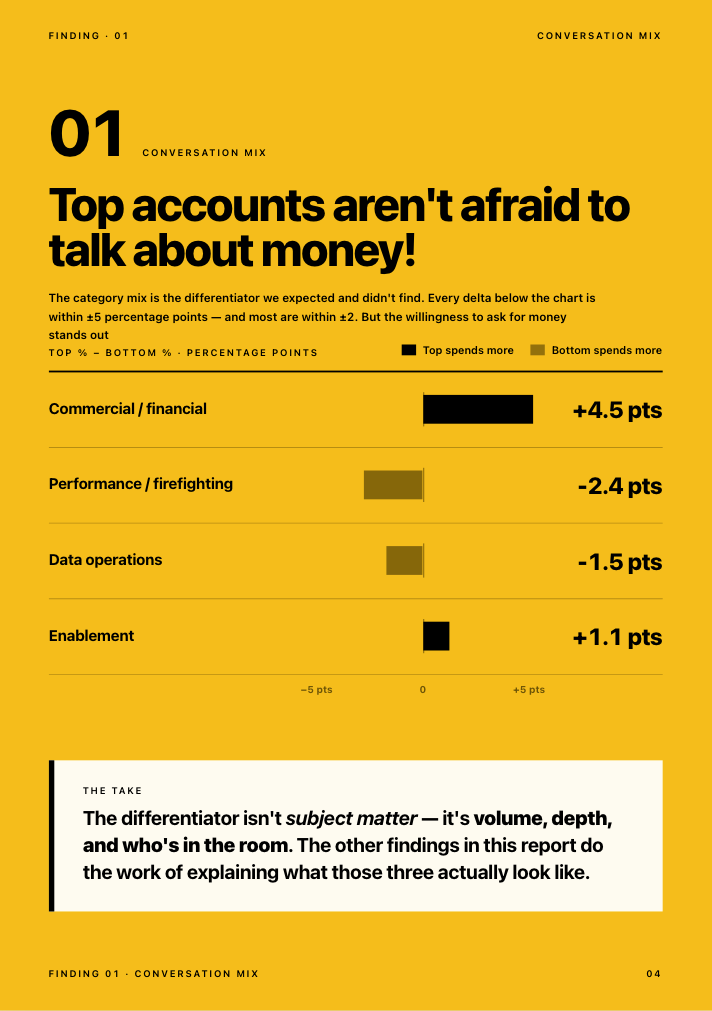
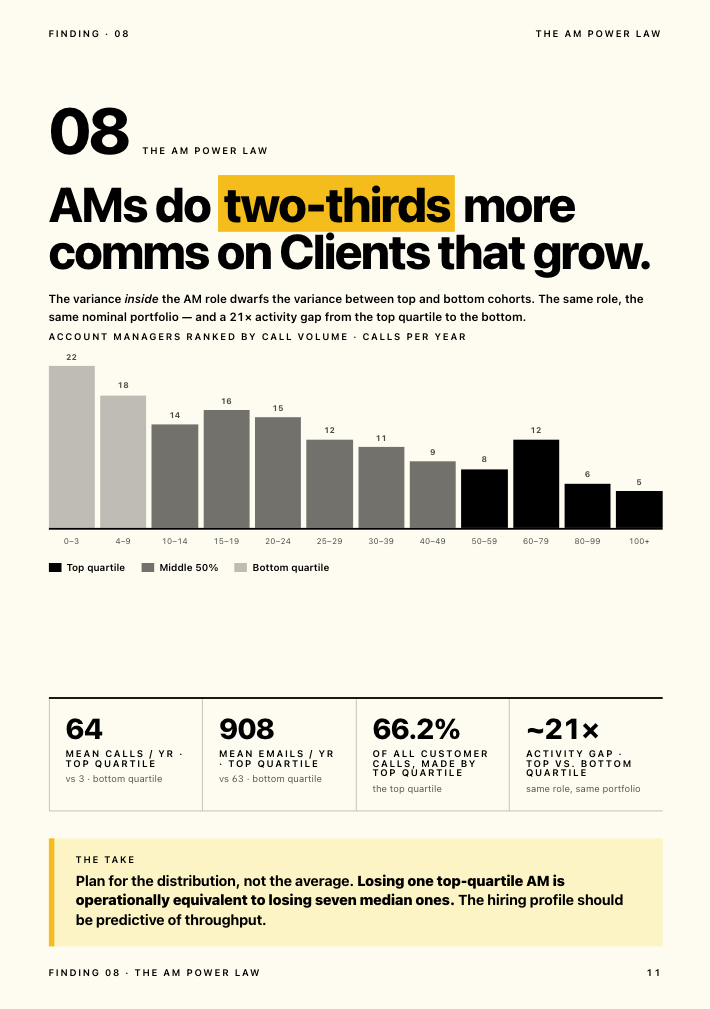
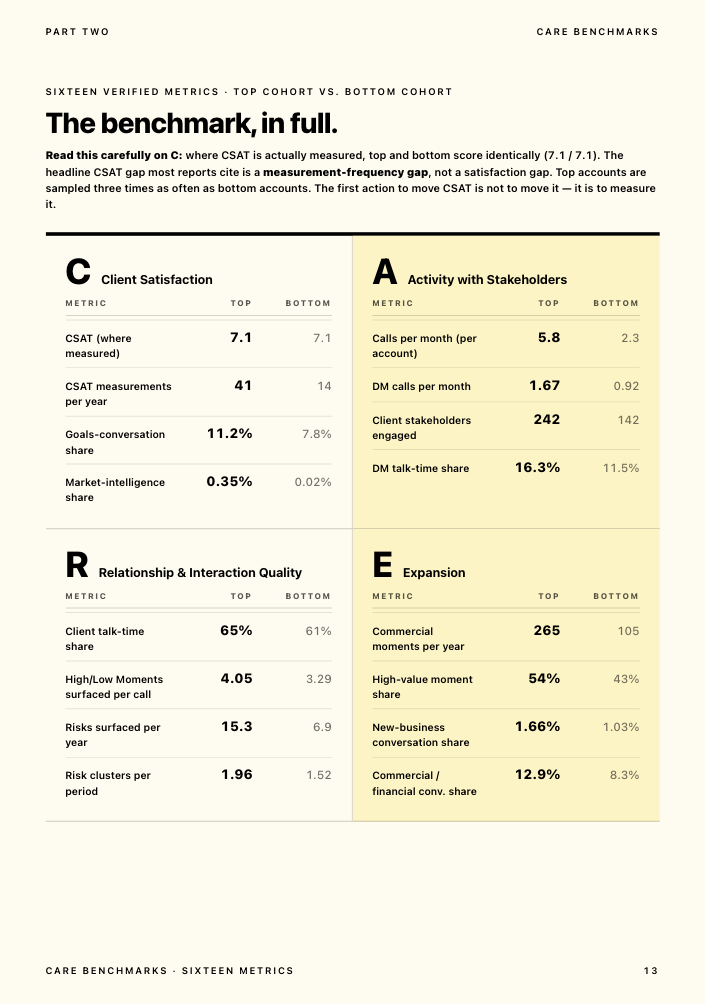
List every stakeholder on your target map, even the ones who've gone quiet, and mark each one Engaged, Needs attention, or At risk based on when they last had a meaningful interaction with your team. This is the section most agencies fill in optimistically, listing who they'd like to be talking to rather than who they're actually talking to. Kaizan's benchmark data found that the gap between the strongest and weakest client relationships isn't usually about which decision-makers an account team has identified. Both groups map roughly the same stakeholders. The strongest accounts just get almost twice as many calls and emails with the actual decision-maker as the weakest ones. The fix is frequency, not a longer contact list.
Risks and mitigations
Name the risk plainly, state its likely impact in business terms, and write what's actually being done about it, with an owner. A clean risk register on an active account is worth questioning, not celebrating. It usually means a risk is being heard somewhere in the account and not written down, more often than it means nothing is wrong.
Where this account can grow
Only fill this section in when the relationship can support it. An expansion pitch dropped into a strained account reads as a sales call, not a partnership, and most clients can tell the difference instantly. For each opportunity, name the signal that triggered it (something the client actually said or did, not a guess) and a next step that's a conversation, not a proposal. Save the proposal for the follow-up.
Agreed actions
Every action needs an owner and a date, not a general sense of direction. Leave space on the slide for the client's own priorities for next quarter too, and write those down verbatim in the room rather than paraphrasing them afterward. A QBR that only records your own commitments is a status update with better formatting.
Common mistakes when filling in a QBR template
Treating it as a status read-out. The moment a quarterly business review becomes a recap of deliverables, it reads to the client as a vendor update, not a partnership conversation.
Filling it in from memory the night before. This is how a stakeholder map ends up optimistic, a risk register ends up empty, and a number ends up three weeks stale. If prep starts the evening before the meeting, it started too late.
Skipping the challenges column. A quarter with zero named challenges isn't a strong quarter. It's a QBR that got edited for comfort before anyone saw it.
Running one format for every account. A top-tier account and a small retained client rarely need the same cadence or the same length of review.
Letting "where this account can grow" drift into a pitch. The clients who feel pitched to in a QBR are the ones who start shopping the account around. Raise growth only when the relationship can carry it.
How to keep your QBR template current without manual updating
The honest version of most QBR prep is an account lead scrolling back through three months of emails and call notes the night before, trying to remember which stakeholder went quiet and when. One agency's Director of AI, Agency Client A, described building an internal tool that pulled Kaizan data straight into their existing QBR process: deck generation that used to take roughly four hours of manual pulling and formatting dropped to about a minute once the health score, risk signals and stakeholder activity fed in automatically rather than being reconstructed from memory each time.
That's the mechanism behind the note on the health snapshot slide above. If your team runs Kaizan, the relationship health boxes, the stakeholder coverage table and the risk register in this template don't need rebuilding from scratch every quarter: they reflect what Kaizan's AI Assistant has already captured from every call, email and chat on the account, continuously, not just in the week before a review. One agency's MD and Chief Client Officer, Agency Client B, put it plainly when describing the same shift in a different report built the same way:
"Kaizan is fast becoming the key input to my churn report. Something that used to take me hours now takes me minutes."
The same pattern shows up in how teams keep the health snapshot current between reviews, not just inside them. James Smith, CEO at The Kite Factory, described the time saved on just the call summaries that feed a section like this one:
"When you come back and see the summary afterwards, it'll take me 15 seconds to read through a summary and be like, actually, what's the sentiment of that meeting? What's happened? What are the key takeouts? It means I can save half an hour, an hour of my time."
If you don't run Kaizan, the next best thing is a standing weekly habit rather than a quarterly scramble: a fixed 15 minutes, same day each week, spent logging what changed on your top accounts since the last check. One Senior Client Partner, Agency Client C, described exactly that kind of lighter, ongoing rhythm: "I use the sentiment tracking a lot in our weekly agency growth meetings to track sentiment. It's really, really invaluable." A QBR built on top of a weekly habit starts from context. One built once a quarter, cold, starts from a guess.
Frequently asked questions
How do I fill in the quarterly business review template? Work through it in the order the slides are built: health snapshot, then the numbers, then wins and challenges, stakeholder coverage, risks, growth opportunities, and finally agreed actions. The walkthrough above explains what a good answer looks like for each section.
How do I keep the QBR template current without redoing it from scratch every quarter? Build a standing weekly habit of logging what changed on your top accounts, or connect the account's real conversation history so the health snapshot, stakeholder table and risk register populate automatically rather than from memory. The section above on keeping it current covers both routes.
If you want your next quarterly business review built from the actual call and email history on the account instead of a memory-based spreadsheet, book a demo.